24 October 2012
'On Track for Business' Parliamentary Reception
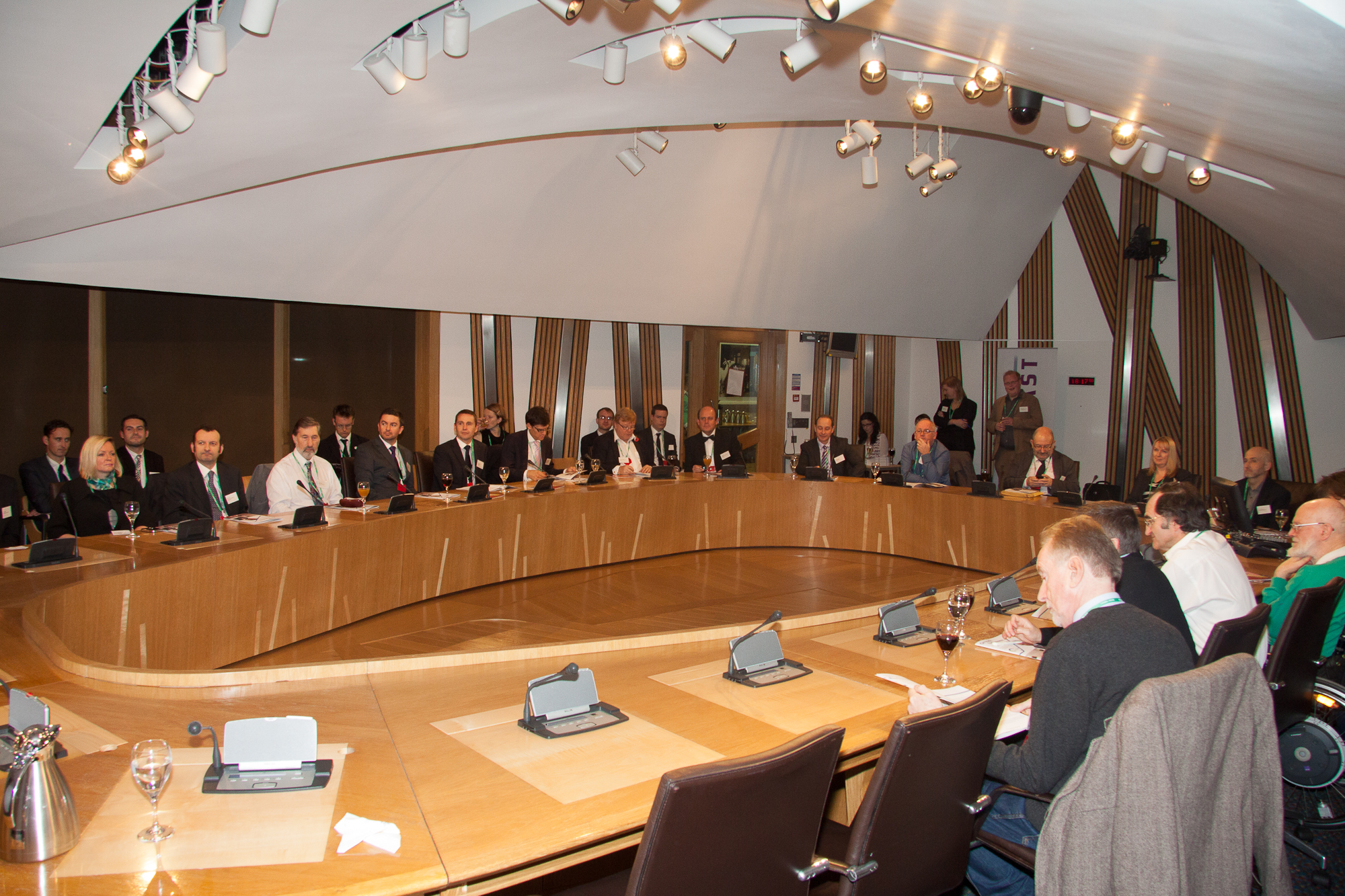
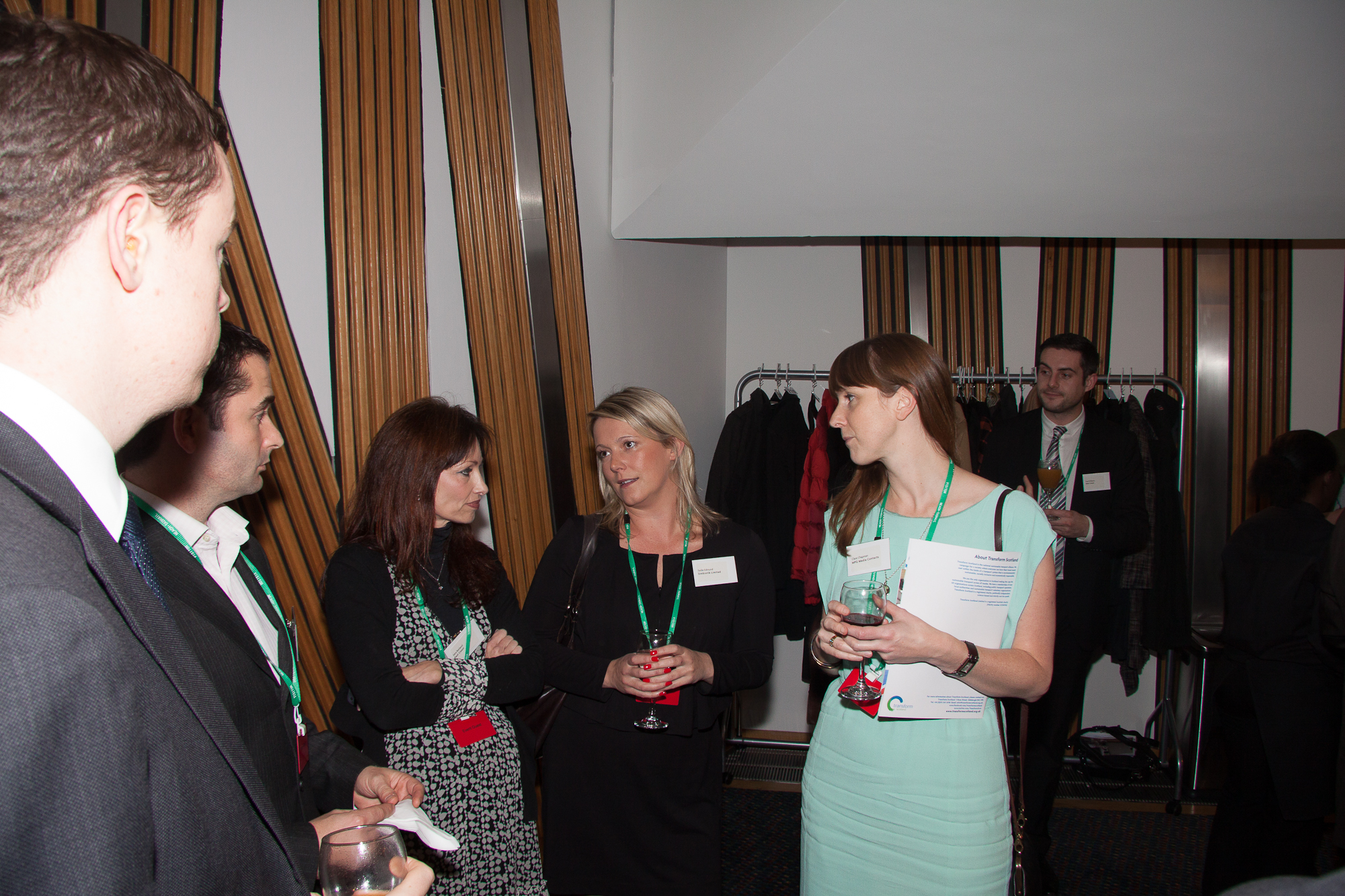
On 24 October 2012, we hosted a reception at the Scottish Parliament in Edinburgh to coincide with the launch of our latest report, On Track for Business: Why Scottish business should try the train. Sponsored by Marco Biagi, MSP, this successful event brought together individuals from Scottish business, the passenger rail industry, and the public sector to highlight the advantages of switching from air to rail for long-distance business travel within the UK. Over 50 attendees were treated to brief talks by David Spaven, author of the report, John Pinkard, Chair of Transform Scotland, and Peter Williams, Commercial Director at East Coast, to drive home several key points, as well as an opportunity to ask questions, voice concerns, and socialize over wine and canapes.
The key message of the evening was the clear benefit to business in making the switch from air to rail . With respect to environmental impact, David noted that total global greenhouse gases have been steadily increasing since the 1990s, with most of this attributable to growth in the air transport sector. Given that a large number of air passengers travel for business purposes between Scotland and London, David stated, the overall impact of business travel on the environment is significant. While the common view may be that air is the more time-effective choice for business travelers, this report’s conclusions resolutely dispel this as a myth, particularly in light of the five advantageous attributes of rail, as discussed by David:
- Competitive pricing - 81% of flights between Edinburgh and London have a cheaper rail alternative, particularly when businesses negotiate bespoke bulk fare rates, which is not possible with air travel, or purchase the ‘Scottish Executive’ ticket by East Coast;
- Journey times - air is only 20 minutes faster than the 05:40 Flying Scotsman to Heathrow, which is in essence negligible;
- Seamless travel - typically, an air journey is disrupted by multiple mode switches when traveling between city centres, (such as cars, buses, taxis and trams) and requires extensive queuing and security checkpoints, whereas rail travel is seamless journey necessitating only 5 minutes for pre-boarding time;
- High-quality travel environment - including more personal space and a desktop for working, and even complimentary food and drink for first class journeys; and
- Productive use of travel time - the layout of rail carriages, particularly into sets of four facing seats, provides opportunities not only for individual work, but collaboration and meetings as well; additionally and unlike flight, there is ample space for laptop use, electrical sockets for electronic devices, Wi-Fi availability, and use of mobile phones is typically permitted in most rail carriages, leading to 80% of business rail passengers stating that they are productive on their journeys.
Following an excellent presentation by David, further support for these advantages were detailed in a discussion by Mr. John Pinkard of two relevant case studies, RBS and SSE. John advised that in both cases the companies sought to switch from air to rail for long-haul domestic business travel by employees, particularly to London, as a means of meeting corporate emissions targets. To date, John noted, RBS has seen a 40% decline in reliance upon air travel, a corresponding increase of 10% in travel by rail, and an overall decrease in employee travel cost as a result of its ability to negotiate contracts with rail travel suppliers. As well, John mentioned, within the previous five years, SSE has witnessed an increase of 40% in the use of rail journeys for business, lower overall costs of business travel, and improved productive use of journey time by employees.
Lastly, Peter further discussed the measures taken by his company to cater to the domestic business travel market, particularly between Edinburgh and London. While it is apparent that the Scottish business travel market is “wedded to the plane”, Peter noted that this was a long outdated mindset concerning air and rail travel, and therefore prime for change. To date, Peter stated that East Coast now offers more frequent services, faster journey times, high-speed Wi-Fi connectivity, an entirely revamped first class offer, and a specialized ‘Scottish Executive’ package tailored specifically to business travelers moving between Scotland and London.
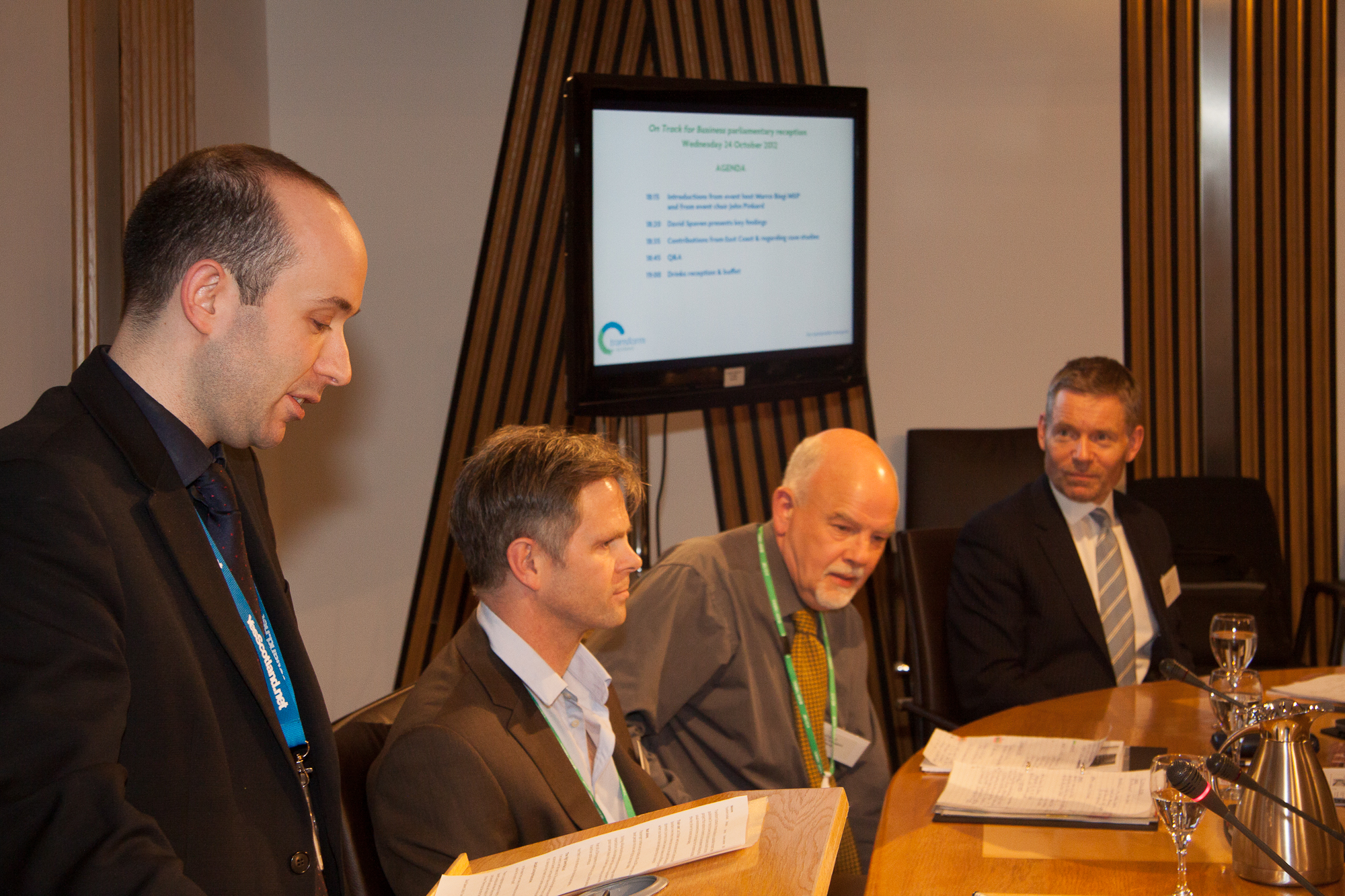
Speakers Marco Biagi, MSP, John Pinkard, David Spaven,
and Peter Williams
At the conclusion of the event, and prior to breaking for wine and appetizers, John returned to the lectern to issue a challenge to Scottish business on behalf of Transform Scotland to get off the plane and try the train. Given the clear environmental, economic and productivity benefits of rail travel for business, Scottish businesses have much to gain in accepting this challenge.
We would like to thank Marco Biagi for hosting the event at the Scottish Parliament, the night’s speakers for providing an engaging and informative launch of the report, and all attendees for making the event a success.